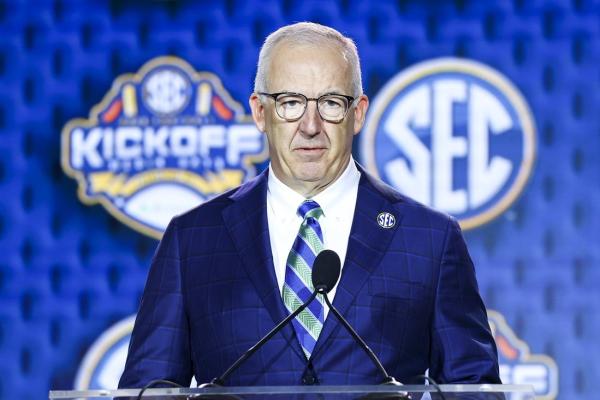
SEC commissioner Greg Sankey said that opening a negotiating window to discuss College Football Playoff expansion does not guarantee a larger field.
Sankey spoke to the Monday Morning Quarterback Club in Birmingham, Ala., amid a hectic start to the college football season, more for off-the-field reasons than for football itself.
Sankey would not comment on the SEC’s lawsuit against LSU in which it sought to affirm it had the authority to expel the Tigers from the conference amid their desire to add former NFL players to their football program.
LSU has since backed off those plans, and its president called the issue “moot.” The SEC has not yet dropped its lawsuit, though a hearing has been postponed.
“I’m happy to talk about football,” Sankey said when asked about a resolution with LSU.
Then there was the topic of CFP expansion, which gained steam again last week when playoff executives agreed to open a 30-day negotiating window with broadcast partner ESPN to explore a 24-team field.
“We’ve participated in that conversation,” Sankey said Monday. “That doesn’t mean expansion will happen. There’s a media negotiation opportunity, which is an important piece of information, and then we’ll have an opportunity, it would appear, later in the fall to make a decision about the future form.”
Sankey added that conference stakeholders met last month to discuss “strategic issues” surrounding the postseason.
“And then we refine — issues around schedule, issues around what might be the economics, issues around the regular season and having common expectations,” he added.
The SEC has been a proponent of a 16-team field in the past, but Sankey sent a memo to the CFP management committee earlier this month outlining what he’d need to see in a 24-team format in order for his league to compromise. Those included an assurance that the CFP would make up for the revenue the SEC would lose by canceling its conference championship game. He also wants an agreement that Power 4 conference teams would have to play 10 games against fellow P4 programs or Notre Dame to be playoff-eligible.
The Big Ten and SEC have the final say on playoff format changes, and they must agree by Dec. 1 for the expansion to take effect for the 2027 season.
Sankey further alluded to the strength-of-schedule sticking point by highlighting the SEC’s top performances over the weekend, which featured Texas taking down then-No. 1 Ohio State and Texas A&M knocking off Arizona State.
“We look at some of (other teams’) schedules. There are a lot of question marks,” he said. “And so having that answer, you know, some better expectation of how we engage in nonconference schedules is important.”